charli chaplin
Childhood
Charles Spencer Chaplin was born in London, England, on April 16th 1889. His father was a versatile vocalist and actor; and his mother, known under the stage name of Lily Harley, was an attractive actress and singer, who gained a reputation for her work in the light opera field. Charlie was thrown on his own resources before he reached the age of ten as the early death of his father and the subsequent illness of his mother made it necessary for Charlie and his brother, Sydney, to fend for themselves.
Having inherited natural talents from their parents, the youngsters took to the stage as the best opportunity for a career. Charlie made his professional debut as a member of a juvenile group called “The Eight Lancashire Lads” and rapidly won popular favour as an outstanding tap dancer.
Beginning of his career

When he was about fourteen, he got his first chance to act in a legitimate stage show, and appeared as “Billy” the page boy, in support of William Gillette in “Sherlock Holmes”. At the close of this engagement, Charlie started a career as a comedian in vaudeville, which eventually took him to the United States in 1910 as a featured player with the Fred Karno Repertoire Company.
He scored an immediate hit with American audiences, particularly with his characterization in a sketch entitled “A Night in an English Music Hall”. When the Fred Karno troupe returned to the United States in the fall of 1912 for a repeat tour, Chaplin was offered a motion picture contract.
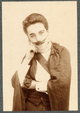
He finally agreed to appear before the cameras at the expiration of his vaudeville commitments in November 1913; and his entrance in the cinema world took place that month when he joined Mack Sennett and the Keystone Film Company. His initial salary was $150 a week, but his overnight success on the screen spurred other producers to start negotiations for his services.
At the completion of his Sennett contract, Chaplin moved on to the Essanay Company (1915) at a large increase. Sydney Chaplin had then arrived from England, and took his brother’s place with Keystone as their leading comedian.
The following year Charlie was even more in demand and signed with the Mutual Film Corporation for a much larger sum to make 12 two-reel comedies. These include “The Floorwalker”, “The Fireman”, “The Vagabond”, “One A.M.” (a production in which he was the only character for the entire two reels with the exception of the entrance of a cab driver in the opening scene), “The Count”, “The Pawnshop”, “Behind the Screen”, “The Rink”, “Easy Street” (heralded as his greatest production up to that time), “The Cure”, “The Immigrant” and “The Adventurer”.
Gaining independence
When his contract with Mutual expired in 1917, Chaplin decided to become an independent producer in a desire for more freedom and greater leisure in making his movies. To that end, he busied himself with the construction of his own studios. This plant was situated in the heart of the residential section of Hollywood at La Brea Avenue.
Early in 1918, Chaplin entered into an agreement with First National Exhibitors’ Circuit, a new organization specially formed to exploit his pictures. His first film under this new deal was “A Dog’s Life”. After this production, he turned his attention to a national tour on behalf of the war effort, following which he made a film the US government used to popularize the Liberty Loan drive: “The Bond”.
His next commercial venture was the production of a comedy dealing with the war. “Shoulder Arms”, released in 1918 at a most opportune time, proved a veritable mirthquake at the box office and added enormously to Chaplin’s popularity. This he followed with “Sunnyside” and “A Day’s Pleasure”, both released in 1919.
In April of that year, Chaplin joined with Mary Pickford, Douglas Fairbanks and D.W. Griffith to found the United Artists Corporation. B.B. Hampton, in his “History of the Movies” says:
“The corporation was organized as a distributor, each of the artists retaining entire control of his or her respective producing activities, delivering to United Artists the completed pictures for distribution on the same general plan they would have followed with a distributing organization which they did not own. The stock of United Artists was divided equally among the founders. This arrangement introduced a new method into the industry. Heretofore, producers and distributors had been the employers, paying salaries and sometimes a share of the profits to the stars. Under the United Artists system, the stars became their own employers. They had to do their own financing, but they received the producer profits that had formerly gone to their employers and each received his share of the profits of the distributing organization.”
However, before he could assume his responsibilities with United Artists, Chaplin had to complete his contract with First National. So early in 1921, he came out with a six-reel masterpiece, The Kid in which he introduced to the screen one of the greatest child actors the world has ever known – Jackie Coogan. The next year, he produced “The Idle Class”, in which he portrayed a dual character.
Then, feeling the need of a complete rest from his motion picture activities, Chaplin sailed for Europe in September 1921. London, Paris, Berlin and other capitals on the continent gave him tumultuous receptions. After an extended vacation, Chaplin returned to Hollywood to resume his picture work and start his active association with United Artists.
Under his arrangement with U.A., Chaplin made eight pictures, each of feature length, in the following order:

was a courageous step in the career of Charles Chaplin. After seventy films in which he himself had appeared in every scene, he now directed a picture in which he merely walked on for a few seconds as an unbilled and unrecognisable extra – a porter at a railroad station. Until this time, every film had been a comedy. A Woman of Paris was a romantic drama. This was not a sudden impulse. For a long time Chaplin had wanted to try his hand at directing a serious film. In the end, the inspiration for A Woman of Paris came from three women. First was Edna Purviance, who had been his ideal partner in more than 35 films. Now, though, he felt that Edna was growing too mature for comedy, and decided to make a film that would launch her on a new career as a dramatic actress.

Chaplin generally strove to separate his work from his private life; but in this case the two became inextricably and painfully mixed. Searching for a new leading lady, he rediscovered Lillita MacMurray, whom he had employed, as a pretty 12-year-old, in The Kid Still not yet sixteen, Lillita was put under contract and re-named Lita Grey. Chaplin quickly embarked on a clandestine affair with her; and when the film was six months into shooting, Lita discovered she was pregnant. Chaplin found himself forced into a marriage which brought misery to both partners, though it produced two sons, Charles Jr and Sydney Chaplin.


